.png)
State capacity for a transforming world: The role of the Public Sector Capabilities Index
The need for government renewal is nothing new. Just as past governments adapted to meet moments of crisis or transformation, today’s governments must rethink how they build capability to respond to the complex demands of the 21st century. Climate adaptation, ageing societies, technological shifts, and rising inequality all require different capabilities than governments inherited. Now the question is, what capabilities enable governments to govern effectively in a complex, interconnected, and resource-constrained environment?
The Public Sector Capabilities Index is being developed precisely in this context. Rather than evaluating performance through traditional indicators, such as budgets, outputs, or satisfaction scores, the Index focuses on something deeper: the dynamic capabilities that equip governments to respond effectively to today’s challenges.
Dynamic capabilities in the public sector are the practices, processes, and ways of working through which governments organise and adapt how they operate over time. They shape how public institutions interpret changing conditions, coordinate across teams and with other urban actors, experiment with new approaches, embed learning into routine practice, and adjust priorities and delivery as circumstances evolve.
These capabilities are not individual skills or isolated initiatives. They are embedded in everyday administrative work and operate together as a continuous cycle of sensing, learning, coordinating, and reconfiguring how government acts under conditions of uncertainty and constraint.
This article introduces the Public Sector Capabilities Index, explains its conceptual foundations, and explores what it reveals about the evolving role of the state in driving transformational change and creating value for citizens and the environment.
Why talk about public sector capabilities?
The question of state capability is ever more urgent. It marks a shift away from an isolated, efficiency-driven view of the state towards a more expansive, systemic, and ambitious understanding of its ability to act. It recognises the state as a networked actor able to adapt, collaborate across and beyond institutions, and mobilise broad coalitions to advance shared missions and steward public value.
This shift reflects a growing mismatch between how public value is created and how government action is commonly assessed. Where value unfolds across systems and over long time horizons, short-term financial viability or conventional cost–benefit analysis offers only partial guidance. Addressing such challenges therefore depends not only on the resources available to government, but on the organisational capabilities that shape how those resources are deployed in practice.
At least three forces are driving this shift.
First is the era of ‘wicked problems’ that are characterised by complexity, transcends traditional policy domains, and require coordinated action from multiple institutions. Systemic issues like housing and climate risk cut across mandates and levels of government, with action in one area catalysing effects elsewhere. Governing under such conditions means navigating interdependencies and adjusting course over time, rather than implementing predefined plans or sector-specific solutions. These issues, from housing crises to demographic pressures, cannot be tackled with isolated interventions or linear plans.
Second is rising citizen expectations. Citizens, quite rightly, increasingly judge public services against the seamless and personalised experiences of consumer services. At the same time, public problems have grown more complex, stretching institutional arrangements designed for a simpler era and making delivery across diverse needs fundamentally more demanding. This combination makes user-centric services and strategic agility essential for governments seeking to respond effectively and sustain public trust.
Third, governments are increasingly shaping markets, rather than acting solely as regulators or service providers. From governments’ responses during the pandemic to long-term energy transitions, governments often influence investment, behaviour, and innovation across systems it does not directly control. Such action unfolds indirectly and over time, with outcomes shaped by how markets and other actors respond. Under these conditions, resources and authority alone are insufficient: translating capacity into sustained outcomes depends on organisational capabilities that allow governments to set direction, sustain coordination, learn from feedback, and adjust course as systems evolve.
Taken together, these pressures drive the need for transformation in how public institutions work, learn, and collaborate. The Public Sector Capabilities Index responds to this challenge by providing a shared framework for understanding, assessing, and strengthening the organisational capabilities through which city governments respond to the everyday realities of urban life, while cultivating cities that can withstand shocks, adapt to change, and support collective wellbeing over time.
What the Public Sector Capabilities Index measures
In partnership with Bloomberg Philanthropies, the Institute for Innovation and Public Purpose (IIPP) at University College London (UCL) has been developing the Public Sector Capabilities Index. The Public Sector Capabilities Index identifies a set of interdependent capabilities that underpin effective governments today.
A first-of-its-kind tool, the Index is designed to help city governments, and those that support their efforts, to assess, strengthen, and celebrate cities’ ability to solve problems, deliver for their residents, and contribute to addressing global challenges.
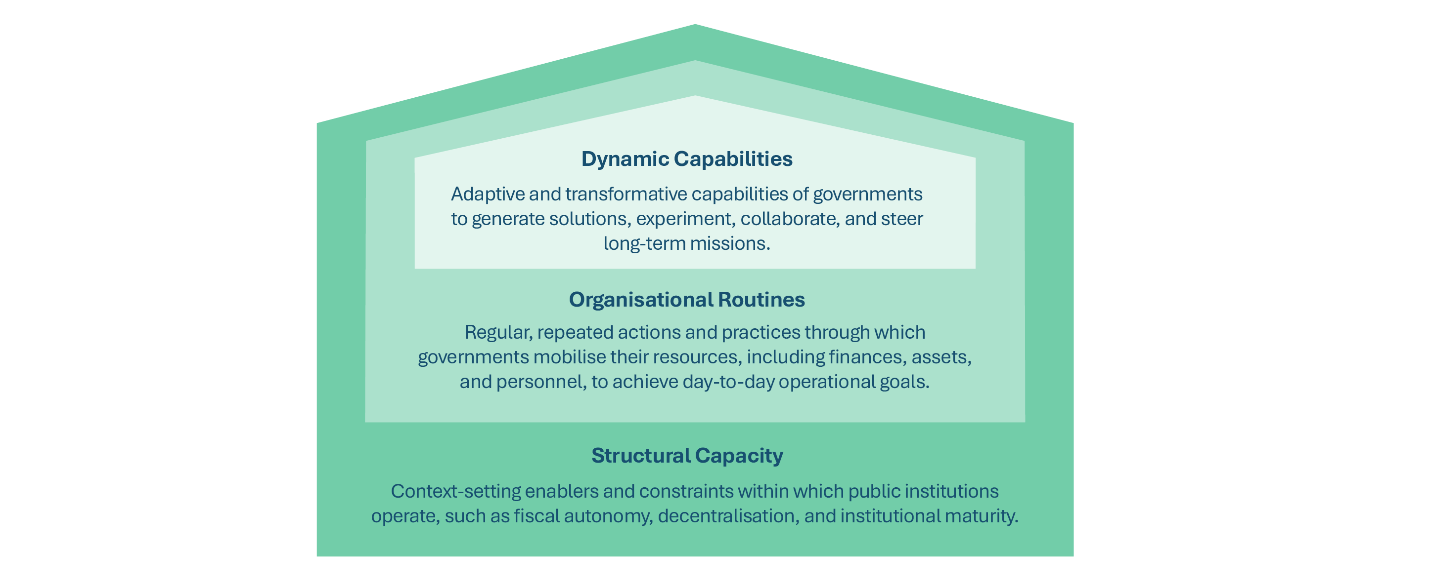
The Index assesses capabilities because these are what transform a government’s capacity into impact. While these terms are often used interchangeably elsewhere, there is an important distinction between capacity and capability. Capacity refers to the resources, structures, and conditions that make it possible for a city to act: its people, funding, tools, and time. Capability refers to the routines, processes, and ways of coordinating that inform how a city deploys its resources: its ability to innovate, adapt, and achieve results.
Without capacity, little is possible. But capacity alone is not enough: without organisational capability, even well-resourced cities struggle to turn ambition into reliable and lasting outcomes.
Through extensive work with those at the frontline of city governance, we have identified five core dynamic capabilities which reflect the diverse practices that cities are striving to embed.
In city administrations, strategic awareness enables long-term risks and opportunities to be systematically incorporated into routine decision-making. For example, in Helsinki, Finland, foresight and resident engagement inform annual planning cycles and budget deliberations, shaping how programmes are prioritised and funded over time.
The capacity to adjust priorities is evident when cities revise strategic focus as conditions change, without relying solely on formal planning cycles. In Glasgow, United Kingdom, reframed its approach to child poverty based on internal reflections on efficacy, moving away from top-down service models to collaborative, family-centred planning.
Effectively building coalitions involves sustained coordination across institutional boundaries. In Medellín, Colombia, a city-backed innovation and economic development agency convenes city departments, universities, and private actors to align initiatives, clarify responsibilities, and coordinate long-term economic transformation efforts.
Where learning and experimentation are embedded, experience is systematically fed back into policy and delivery. In Cape Town, South Africa, lessons from pilots and crisis responses are incorporated through structured review processes that inform service standards and operational practices before changes are scaled across departments.
The ability to reconfigure delivery is visible when organisational arrangements are adapted to evolving priorities. In Bogotá, Colombia, cross-cutting innovation and data units support line departments by redesigning workflows and sharing analytical capacity, enabling changes in delivery without dismantling existing administrative structures.
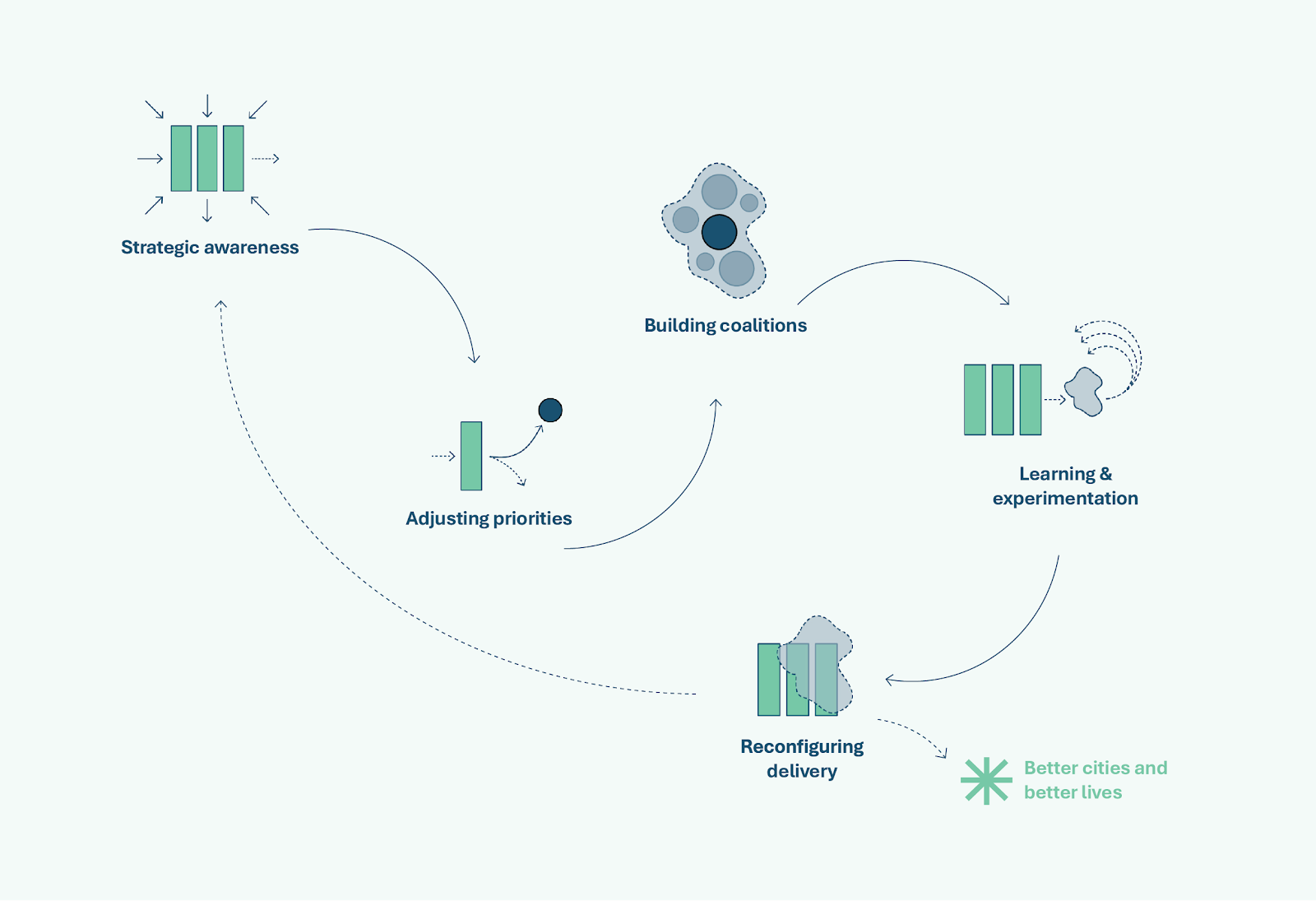
Dynamic capabilities are not a checklist. They are an ecosystem of capabilities that must function together. Strong delivery without strategic direction leads to piecemeal activity, and at best episodic innovation. Strong strategy without learning leads to rigidity. Strong idea generation without delivery leads to prototypes that never scale. The value of the Public Sector Capabilities Index lies in showing how these capabilities interact and where gaps create systemic risk.
Describing what strong dynamic capabilities look like offers a starting point for others to learn from, but such capabilities are not fixed – they emerge, take shape and evolve through practice. As more cities work in this way, the benchmark of best-in-class capabilities will be progressively raised, while the range of effective practices continues to deepen and diversify.
By assessing capabilities across key domains, the Index provides cities with a clear-eyed view of their strengths and gaps. It helps shape realistic learning journeys that guide cities from their current position towards stronger practice; it offers a sense of direction, a route to follow, and a way to track progress over time.
But the real power of the Public Sector Capabilities Index begins after the assessment. Once a city understands its position, the next step is to act - building its dynamic capabilities while navigating the fiscal, legal, and procedural barriers that hold back problem-solving and innovation. This means interrogating what is a rule, what is a norm, what is a law, and what is simply tradition, and then working collectively with national and regional governments, development banks, foundations, and other funders, to overcome those barriers and enable a new solution-focused government to flourish.
Why the Public Sector Capabilities Index matters
The Index challenges old assumptions about public administration. Instead of focusing on efficiency metrics or isolated performance targets, it introduces a holistic understanding of what modern governments need to succeed. It recognises that transformation is not just about new policies, but it is also about new capabilities.
The index provides three key contributions:
- A shared language for describing what city government capability looks like.
- A diagnostic tool for identifying strengths and gaps across cities and geographies.
- A strategic pathway for investment in public sector reform, helping guide the funding within cities and those that support them, including national and regional governments, development banks, and philanthropy.
City governments interested in the Public Sector Capabilities Index can register their interest via this form. Participation takes the form of a light-touch assessment, based on structured conversations with senior officials. For cities involved, the Index provides a structured opportunity to reflect on how their organisations function in practice, inform strategic decisions about where to focus capability-building efforts, and contribute to an international research effort on public sector capability.
A capable state for a transforming society
The debates around state capacity are often polarised - too big, too small, too slow, too bureaucratic. The Public Sector Capabilities Index reframes the conversation. The critical question is not the size of the state, but the capabilities of the state.
If governments are to deliver social, economic and environmental value, they must build the organisational muscle to act confidently and collaboratively. They must become learning organisations, mission-driven institutions, and stewards of long-term societal wellbeing.
The Public Sector Capabilities Index shows what that looks like in practice. It is both a mirror and a roadmap; it reflects where governments stand today and guides where they need to go.
___________________________________________
Editorial Note:
This article is produced as part of a collaboration between Rethinking Economics International, Makronom and the Economists for Future DE and was originally written in German language. The 2026 contributions engage with ongoing debates on anti-authoritarian and anti-fascist perspectives on economic policy, with particular attention to how social security arrangements can help counter authoritarian and nationalist tendencies. Contributions in this series also explore welfare state design, property relations, pension systems, and institutional reforms with a view to strengthening democratic cohesion, ecological stability, and economic resilience. The views expressed in this article are the author’s own and do not necessarily reflect those of the participating platforms.
About the authors:
Mariana Mazzucato is Professor at University College London (UCL), where she is Founding Director of the UCL Institute for Innovation & Public Purpose (IIPP).
Rainer Kattel is Deputy Director and Professor of Innovation and Public Governance at the UCL Institute for Innovation and Public Purpose (IIPP).
Ruth Puttick is an Honorary Research Fellow at UCL Institute for Innovation and Public Purpose (IIPP).
Bec Chau is a Senior Research Fellow at the UCL Institute for Innovation and Public Purpose (IIPP).
____________________________________________


