.png)
Green Hydrogen, Local Voices, and Climate Justice: Why Bottom-Up Governance Matters in Gabès
Introduction
Green Hydrogen (GH) is becoming central to the EU's targets achieving climate neutrality and strengthening energy security. Under the REPowerEU Plan, the EU aims to consume 20 million tonnes of renewable hydrogen annually by 2030, with half imported from partner countries. Due to its geographical proximity, abundant solar and wind resources, and existing energy export infrastructure, North African (NA) countries are being targeted as strategic suppliers of GH. Consequently, the governments of Egypt, Morocco, and Tunisia have adopted ambitious GH strategies, including partnerships with European governments and supported by international financial institutions (Buonomenna and Patonia 2025).
From a Global South perspective, however, these partnerships expose a mismatch in climate priorities. While the EU's hydrogen agenda is driven by climate change mitigation and energy security, NA countries face a more complex set of challenges. Although they are also exposed to energy security concerns, particularly given the dependence of Tunisia and Morocco on fossil-fuel imports and exposure to volatile international energy prices, they are simultaneously among the regions most vulnerable to climate change and face acute adaptation challenges. NA countries contribute minimally to global greenhouse gas emissions. Yet they are among the regions most vulnerable to climate change. Impacts such as water scarcity, drought, and ecosystem degradation make climate adaptation their most pressing challenge. Nevertheless, the pursuit of foreign investment by national governments is ultimately shaping national energy policies to align with European demand.
For NA governments, many of which operate under highly centralized political systems with limited mechanisms for local participation and accountability, GH is seen as an opportunity to attract foreign investment and generate foreign exchange reserves. This is particularly important in economies facing persistent external financing constraints and high import bills, including for energy and food commodities. National GH strategies may therefore prioritize export revenues, investment, and integration into emerging international hydrogen markets. However, these priorities do not necessarily correspond to the adaptation needs of communities most exposed to climate and environmental change. The development of export-oriented GH projects can therefore create a convergence between European demand for low-carbon energy and national governments’ need for foreign investment and foreign exchange, while leaving open the question of whether—and to what extent—the priorities of affected local communities are reflected in project design and national energy strategies (Hamouchene and Chavez 2025).
Climate Justice at Stake: Policy Implications of GH in Gabès, Tunisia
The selection of Gabès as the pilot site for Tunisia's National GH Strategy, developed in partnership with GIZ (the German state-led development agency), illustrates how international climate policies can reshape domestic development priorities. Under this strategy, around 75% of the projected national hydrogen production (8.3 million tonnes) is intended for export to Europe, in line with the EU's objective under REPowerEU to secure renewable hydrogen imports (Ministry of Industry, Mines, and Energy 2024). While these targets are presented as an opportunity for economic growth and decarbonization, they redirect political attention and financial resources towards export-oriented climate mitigation rather than domestic adaptation challenges that are most pressing for NA countries.
This shift is particularly significant in a region facing increasing water scarcity, desertification, and declining agricultural productivity. Figures 1 and 2 illustrate this asymmetry: NA countries have substantially lower per-capita CO₂ emissions than European countries, while several face considerably greater pressure on available freshwater resources.
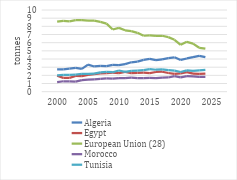
Source: Our World in Data, 2026
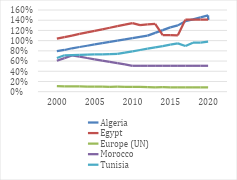
Source: Our World in Data, 2026
Tunisia’s National GH Strategy is centered around the existing phosphate and fertilizer industry. It seeks to decarbonize an export-oriented industrial complex using GH to locally produce ammonia that feeds into the industry, without addressing its longstanding environmental and social impacts (Akrimi 2023). Additionally, its purpose is to demonstrate the feasibility of the wider national hydrogen strategy, whose long-term orientation is strongly export-oriented. Between 2025 and 2030, the pilot project should integrate an 8 MW solar photovoltaic plant, a seawater desalination unit, an electrolyzer, hydrogen storage, and a Haber–Bosch synthesis unit to produce approximately 220 tonnes of GH and 630 tonnes of green ammonia annually. Around 70% of the hydrogen produced in the pilot will be used to manufacture green ammonia, replacing grey ammonia imported by the Groupe Chimique Tunisien (GCT), while the remainder will be stored for continuous production. The project is intended to demonstrate the technical and commercial feasibility of green ammonia production and serves as the first step towards implementing Tunisia's National GH Strategy.
While this approach reduces the carbon intensity of fertilizer production, it leaves intact the broader environmental legacy of the phosphate industry, including marine pollution, biodiversity loss, toxic waste, groundwater depletion, and ecosystem degradation. From a climate justice perspective, the project therefore risks greening an environmentally contested industry rather than transforming it. Decarbonization of the phosphate industry can become an example of a successful transition, however, such transition does not address the wider environmental and social harms generated by the underlying industrial system.
The governance model underpinning national GH strategies in the region and their implementation further reinforces these concerns. Strategic investment decisions are negotiated primarily between government institutions, international financial institutions, and foreign investors. At the same time, participation by municipalities, civil society, or affected communities is limited. In contexts where democratic accountability is weak, this top-down approach increases the likelihood that renewable energy projects are perceived as externally imposed rather than locally driven (ReCommon 2026). Beyond raising concerns about procedural justice, excluding local communities undermines the social legitimacy of the transition and increases the risk of resistance, implementation delays, and future conflicts (Komendantova et al. 2014).
Project Siting and Land Governance: The Missing Role of Local Knowledge
Tunisia's GH Strategy is developed through a policymaking process primarily driven by technical, financial, and logistical considerations. Site selection for renewable energy infrastructure is based on criteria such as solar irradiation, proximity to existing industrial facilities, access to the electricity grid, and project costs (Ministry of Industry, Mines, and Energy 2024). While these factors are essential for assessing technical feasibility, they often fail to capture how land is used and valued by local communities.
This is particularly evident in Gabès. The photovoltaic park supplying electricity to the GH pilot will be located approximately 18 km west of the GCT complex, near the town of Oudhref. The site was selected because of its proximity to the national grid and its ability to supply the industrial complex efficiently. However, Oudhref forms part of the wider coastal oasis landscape of Gabès, a distinctive agro-ecological system in which agriculture has historically been sustained by freshwater resources. Research on the Gabès oasis documents its importance as an agricultural and cultural heritage landscape, while also highlighting the pressures of urbanization, fragmentation, abandonment, and environmental degradation that have progressively reduced its extent (Lassoued and Rejeb 2016). Historical and local accounts further identify Oudhref, alongside Ghannouch and Chenini, as an area sustained by freshwater springs and associated with the cultivation of dates, henna, fruit, and vegetables (Benhammadi 2026).
The treatment of such land as "available" illustrates a broader governance challenge. Technical assessments often classify land according to engineering suitability rather than its ecological, social, and economic functions. Yet, local farmers and pastoralists possess detailed knowledge of groundwater availability, soil quality, seasonal grazing patterns, biodiversity, and traditional water management systems that have enabled communities to adapt to the fragile environment of the coastal oasis for centuries. This knowledge rarely informs decisions on project siting or land allocation (Wafa Kharfia, ‘Interview on Green Hydrogen Project in Gabès’, 13 July 2026).
Community Perspectives from Gabès: Evidence of an Unjust Transition
Community responses in Gabès demonstrate that opposition to GH is not an opposition to renewable energy. Rather, it reflects accumulated distrust resulting from decades of environmental degradation and exclusion from development policy decisions.
Gabès has long borne the environmental costs of Tunisia's phosphate and fertilizer industries. Industrial pollution has damaged the Gulf of Gabès, one of the Mediterranean's most important coastal ecosystems, while agricultural land has become less productive because of soil degradation, groundwater depletion, and saltwater intrusion. Fishers report declining catches, farmers face increasing water shortages, and many residents associate industrial activity with deteriorating public health and declining quality of life (Ilyes Ben Ammar, ‘Interview on Green Transition in Tunisia’, 14 July 2026).
Against this backdrop, many civil society organizations interpret the announcement of GH investments as a continuation rather than a transformation of the existing development model. In a statement issued on 16 May 2026, Stop Pollution Gabès condemned the continued operation of polluting industrial units and criticized the government’s plans to rehabilitate these units, expand phosphate transport infrastructure, and proceed with planned GH and ammonia projects in the region. The movement argues that these initiatives fail to respond to residents’ longstanding demands to dismantle the polluting industrial units and address the environmental and health burdens imposed on the region. Consequently, the proposed transition is widely perceived as serving European decarbonization objectives while leaving existing local burdens largely unchanged.
These concerns became visible during the large demonstrations held in Gabès in 2025, when thousands of residents and environmental activists protested against planned hydrogen projects and questioned why large-scale investments were directed towards energy exports while local communities continue to experience water shortages, environmental pollution, and inadequate public services. Tunisian researchers and environmental advocates continue to express similar concerns. “Tunisia’s energy transition should first respond to national and local development priorities by ensuring that domestic energy needs are met at affordable prices for local communities before pursuing export-oriented hydrogen production and European energy markets”, said Wafa Kharfia, an activist and the director of documentary I am a Violator, which focuses on smallholder women farmers in Tunisia (‘Interview on Green Hydrogen Project in Gabès’, 13 July 2026)
Comparable experiences across North African countries reinforce this conclusion. Controversies surrounding Morocco's Noor Solar Complex and Egypt's Benban Solar Park similarly reveal that renewable energy projects are more likely to gain public acceptance when they generate tangible local benefits, protect livelihoods, and involve communities in decision-making. Together, these cases suggest that the principal challenge for the green transition is not technological feasibility but its governance. Renewable energy will only contribute to a just transition when affected communities become active partners in shaping—not merely hosting—the transformation (Urbasos 2024).
Rethinking European GH Partnerships: Policy Recommendations for a Just Transition
The case of Gabès illustrates a central paradox of the energy transition: a technology intended to address climate change can reinforce existing inequalities when implemented through unequal governance structures. Therefore, the question is not whether Europe should cooperate with North Africa on GH, but how these partnerships are designed and governed. Pursuing European decarbonization and energy-security objectives without sufficient consideration of local development priorities risks reproducing extractive patterns of energy and resource development.
The central challenge is to institutionalize meaningful community participation in renewable energy and GH governance. Participation can range from consultation and representation on project governance bodies to benefit-sharing, municipal participation, cooperatives, community trusts, and, where appropriate, community ownership (Dzreke and Dzreke 2025; Bidwell 2016). Such participation can increase public acceptance and reduce conflict and implementation delays (Zoellner et al. 2008); protect agricultural and pastoral livelihoods, and improve project design by incorporating local knowledge of land, water, ecosystems, and seasonal resource use (Antunes et al. 2025). It can also strengthen democratic accountability and the political leverage of communities in relation to centralized national governments and international investors (Yi 2026).
This participatory approach does also have implications for European energy security. Replacing one external energy supplier with another does not necessarily eliminate vulnerability. Hydrogen partnerships that generate local opposition, deepen inequalities, or depend on centralized foreign-owned infrastructure can create new social and political risks for both producers and consumers. By contrast, partnerships that generate tangible local benefits and give communities a meaningful stake in their success can strengthen their legitimacy, resilience, and long-term reliability.
Integrating community participation into REPowerEU
The EU could incorporate this principle into REPowerEU through three specific changes:
- Meaningful community participation a condition of EU financing: eligibility for EU grants, guarantees, and concessional finance for GH projects should require evidence of community involvement from project design and site selection through implementation and monitoring, including formal representation of affected stakeholders in project governance.
- Social and livelihood impacts part of project approval: EU-supported projects should require environmental and social assessments that explicitly evaluate impacts on agriculture, pastoralism, water access, and other locally important resource uses, alongside technical and financial feasibility. Local knowledge should be formally incorporated into siting and resource-allocation decisions.
- Local benefit-sharing and accountability mechanisms: EU-supported projects should demonstrate how local communities will benefit from investments through mechanisms such as community development funds, municipal participation, cooperative ownership, local employment and skills development, or other locally appropriate arrangements. Financing agreements should also require disclosure of project ownership, public financing and guarantees, expected revenues, and the distribution of economic benefits. This is particularly important in the case of Gabès, where publicly available information makes it difficult to assess the project's full financial feasibility and the magnitude and distribution of its expected economic benefits.
These conditions would allow REPowerEU to move beyond securing alternative sources of low-carbon energy towards building mutually beneficial and politically resilient energy partnerships.
Ultimately, the case of Gabès shows that the energy transition is as much a political and social transformation as it is a technological one (Othmen 2025; Ammar 2026). Whether GH becomes a catalyst for sustainable development or another form of green extractivism will depend on who shapes investment decisions, who benefits from them, and whether local communities are recognized as equal partners in the transition.
___________________________________________
About the Author
Mariam Attalla is an Egyptian economist specializing in economic development, energy economics, and climate change, with experience across the EU, North Africa, and Western Asia. She holds Master’s degrees in Economic Policy and Analysis from the University of Paris Nord and in Development Theory and Policy from the University of the Witwatersrand.
___________________________________________
References
Akrimi, Yasmine. 2023. ‘Phosphate Pollution in Gabès – Impacts and Possible Ways Out.’ Brussels International Center, July 14. https://www.bic-rhr.com/research/phosphate-pollution-in-gabes---impacts-and-possible-ways-out.
Ammar, Ilyes Ben. 2026. ‘Towards a Just Energy Transition in Tunisia | Transnational Institute’. June 30. https://www.tni.org/en/publication/towards-a-just-energy-transition-in-tunisia.
Antunes, Tayná Padilha Basqueroto, Luana Oliveira Bernardes, and Edward Antunes. 2025. ‘Community Engagement and Renewable Energy Transitions in Agricultural Landscapes: A Comparative Analysis of Global North and South’. Asian Journal of Agricultural Extension, Economics & Sociology 43 (11): 11–21.
Benhammadi, Nesrine. 2026. ‘Gabès, A Lost Earthly Paradise: Between the Forefathers’ Generation and Generation Z’. Greenpeace Middle East and North Africa, January 26. https://www.greenpeace.org/mena/en/gabes-a-lost-earthly-paradise-between-the-forefathers-generation-and-generation-z/.
Bidwell, David. 2016. ‘Thinking through Participation in Renewable Energy Decisions’. Nature Energy 1 (5): 16051. https://doi.org/10.1038/nenergy.2016.51.
Buonomenna, Maria Giovanna, and Aliaksei Patonia. 2025. ‘Green Hydrogen in Europe: Where Are We Now?’ Hydrogen 6 (4): 105. https://doi.org/10.3390/hydrogen6040105.
Dzreke, Simon, and Semefa Dzreke. 2025. ‘The Renewable Energy Dilemma: Who Benefits from Africa’s Green Transition?’ Advanced Research Journal 12 (October): 32–49. https://doi.org/10.71350/3062192599.
European Commission. 2022. ‘REPowerEU - Affordable, secure and sustainable energy for Europe’. Updated 31 May 2026. https://commission.europa.eu/topics/energy/repowereu_en.
Hamouchene, Hamza, and Daniel Chavez. 2025. Green Industrial Policy in North Africa: Between Energy Sovereignty, Authoritarian Governance and Neocolonial Extraction (Case Study 8). Deliverable D3.4: Synthesis of WP3 Results. GreenPaths project. Horizon Europe. Grant Agreement No 101112305. https://repositorio.unican.es/xmlui/bitstream/handle/10902/40273/D3.4._Case-Study-8.pdf?sequence=1.
Komendantova, Nadejda, Stefan Pfenninger, and Anthony Patt. 2014. ‘Governance Barriers to Renewable Energy in North Africa’. The International Spectator 49 (2): 50–65. https://doi.org/10.1080/03932729.2014.907627.
Lassoued, Khaoula, and Hichem Rejeb. 2016. ‘The Oasis of Gabes in Tunisia: An Endangered Authenticity’. Research Journal of Social Science and Management 6 (7): 80–87.
Ministry of Industry, Mines, and Energy, Tunisia. 2024. National Strategy for the Development of Green Hydrogen and Its Derivatives in Tunisia. https://www.energiemines.gov.tn/fileadmin/docs-u1/Re%CC%81sume%CC%81_strate%CC%81gie_nationale_MIME_Anglais.pdf.
Othmen, Amani. 2025. ‘Roundtable Report – In Pursuit of Energy Transition: Will Tunisia Escape Green Colonialism?’ Arab Reform Initiative, June 19. https://www.arab-reform.net/publication/will-tunisia-escape-green-colonialism/.
ReCommon. 2026. ‘In Tunisia, Gabès Takes to the Streets to Protest against Green Hydrogen’. ReCommon, January 28. https://www.recommon.org/en/in-tunisia-gabes-takes-to-the-streets-to-protest-against-green-hydrogen/.
Urbasos, Ignacio. 2024. Lessons Learnt from the Failure of the Mediterranean Solar Plan for the Success of a Mediterranean Green Hydrogen Partnership. Policy Brief No. 145. Euromesco.
Yi, HyunAh. 2026. ‘When Justice Matters: Community Participation, Power Dynamics, and Community Renewable Energy in Cambodia’. Energy for Sustainable Development 94 (October): 102064. https://doi.org/10.1016/j.esd.2026.102064.
Zoellner, Jan, Petra Schweizer-Ries, and Christin Wemheuer. 2008. ‘Public Acceptance of Renewable Energies: Results from Case Studies in Germany’. Energy Policy, Transition towards Sustainable Energy Systems, vol. 36 (11): 4136–41. https://doi.org/10.1016/j.enpol.2008.06.026.


