.png)
Climate-social policy: The guiding star for transformation
Heat waves, droughts, wildfires running out of control, floods, historically unprecedented cold spells, hail, or extreme storms: the list of climate-crisis-related extreme weather events worldwide rose to 123 for July 2025. The climate crisis is showing its destructive effects all around the globe. The pressure to act is great. The challenges are tangible and especially pronounced from a social perspective as well (in this article, I am restricting my analysis to the households in Germany). Lower-income people suffer significantly more from the consequences of extreme weather events. To protect themselves, they usually lack the material, physical, and structural means. Rising costs for climate adaptation will increasingly burden public budgets, and relevant parts will probably also be shifted into private responsibility.
Already, there are noticeable social imbalances in Germany such as housing shortages and rising rents, the effects of the economic recession, the strained finances of municipalities, and the increasing burdens on social insurance carriers — exacerbated by non-insured benefits. These continue to grow and contribute to a climate of profound social anxiety. A major amplifier of these problems was Russia’s war of aggression against Ukraine, which, due to Germany’s dependence on fossil gas, triggered inflation, initially in the form of sharply rising energy prices and uncertain supply. The unpredictable cost increases and the obvious vulnerability have left people feeling deeply insecure. Especially in the lower income segment, where the recent inflation is felt most strongly, people are haunted by fear of losing their standard of living and become anxious about the future. Many experience politics in general as unjust.
Understanding multi-dimensional poverty is relevant to climate policy
These are mostly not only abstract fears — the impoverishment exists in reality. Further climate-protection-induced cost burdens are not bearable for many households. A relevant share, for example, is financially overburdened by rent payments. In the 77 largest German cities, more than 4.4 million households live in dwellings that are too small (with respect to the floor-area measure customary in social law and housing policy benchmarks) or too expensive for the household income (gross rent is higher than 30 percent of available net household income). That corresponds to 53 percent of all rented households in these large cities. The provision gap concentrates among poorer single-person households, single parents, renters with low educational qualifications, and people with a migration background. These are also the groups that belong to the 11.4 percent of the population living in overcrowded housing. Poverty situations also appear in energy consumption and access to mobility. Depending on the definition, between 5 percent (equivalent to 1 million households) and 33 percent (7.2 million households) of the lower half of the income distribution in Germany are affected by energy poverty. They lack access to essential energy services. Notably, energy poverty does not only occur in the lowest income groups but also extends into the middle of the income distribution.
Mobility poverty is also a real but hitherto little-noticed problem. In Germany, no figures are collected for this complex issue. Agora Verkehrswende identifies four influencing factors: affordability (mobility offers are too expensive), accessibility (places of daily need are too far away), availability (a suitable mobility offer is lacking), and time poverty (a high time expenditure for necessary mobility, with the consequence that time for rest or social life is missing). Those affected are primarily people who do not own a car or for whom car ownership is actually too expensive.
The social imbalance in climate policy
Instead of specifically overcoming poverty situations, climate policy to date shows a social imbalance. It essentially consists of subsidies and pricing instruments. From the central subsidy program in the building sector, the Federal Funding for Efficient Buildings (BEG), the main beneficiaries — besides institutional landlords — have been owner-occupiers with above-average incomes and high educational attainment. Renters, by contrast, finance the majority of renovation costs via the modernization surcharge (up to eight percent of the cost of a modernization) indefinitely as part of their rent, while owners profit from the increased property value.
Another climate policy measure is pricing. The expansion of renewable energies was financed until mid-2022 by the Renewable Energy Surcharge (EEG surcharge), a regressive surcharge on every kilowatt hour (kWh) consumed. As a result, poorer people spent a threefold larger share of their income on the EEG surcharge than higher income groups. The EEG surcharge was abolished in mid-2022; feed-in remuneration is now financed from the federal budget. With carbon pricing, another climate-politically sensible but socially regressive system was established, which disadvantages lower-income households.
Climate-social policy
Climate policy in Germany is now in a phase that affects every household budget. Heat supply must be decarbonized, the building stock must be energetically upgraded, and transport must be transformed to be climate-friendly. Political regulations affect the boiler room and everyday mobility just as much as the areas of nutrition, health, and social policy. To distribute the opportunities and challenges fairly, the development of a climate-social policy is required.
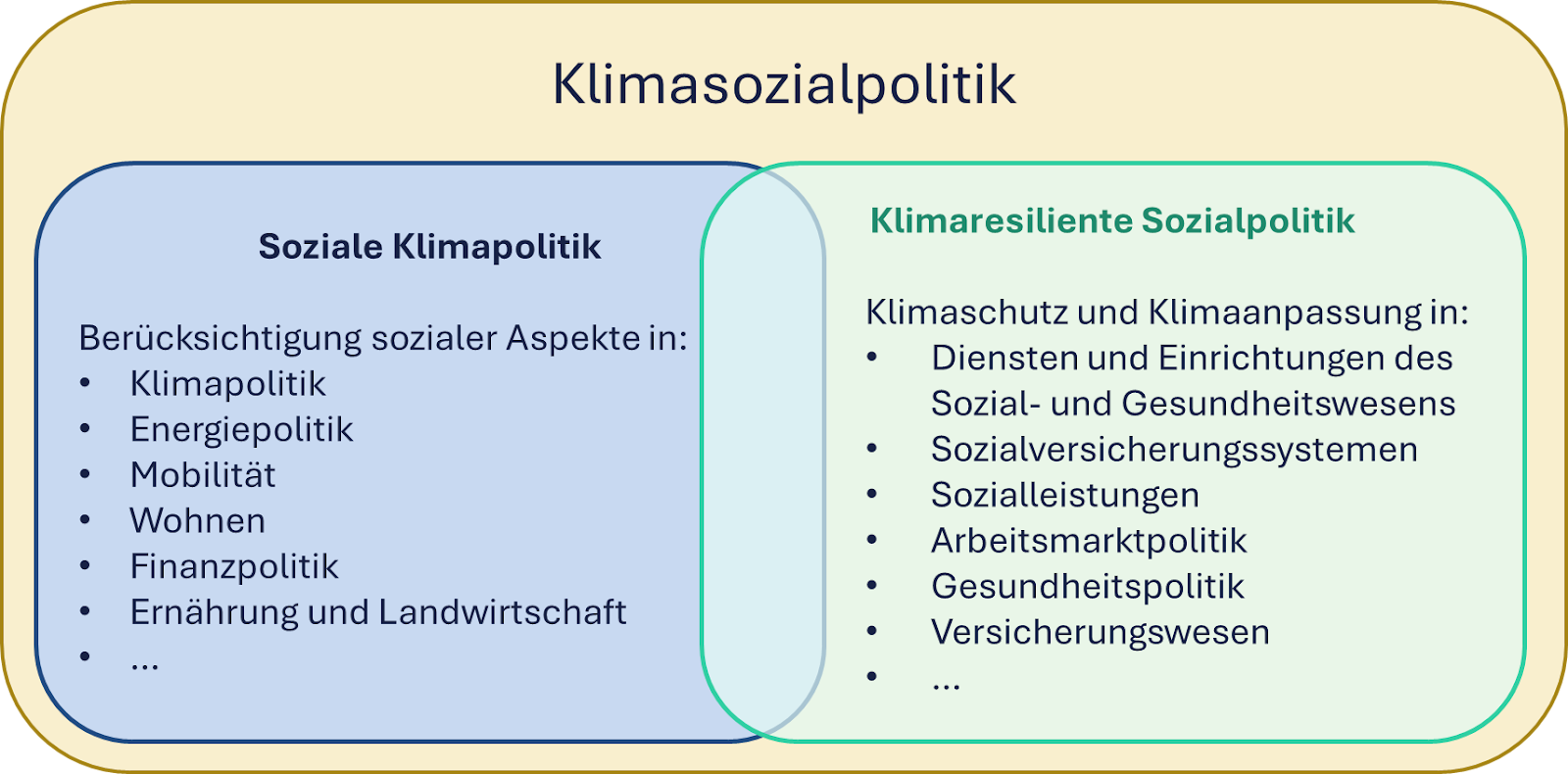
It essentially consists of two areas: a social climate policy, i.e., the consideration of social aspects in policy fields relevant to climate protection; and, in addition, a climate-resilient social policy. Here ideas must be developed about where social policy needs to integrate climate protection and climate adaptation more strongly. They range from heat protection not only in health facilities but also in home care, to targeted measures to offset extraordinary cost burdens, and the integration of participation in climate protection into the catalogs of social-law benefits. The goal must be to enable transformation for all people, not to postpone transformation for households burdened by poverty. In particular, they should be given the opportunities associated with climate neutrality. These range from traffic calming and reduced noise and fine particulate emissions to increased living comfort through energetically upgraded homes, access to climate-friendly mobility and enhanced participation opportunities.
Four pillars of enabling and relief
From a social perspective, therefore, the strategy of enabling, relief and requiring must be promoted, consisting of four pillars.
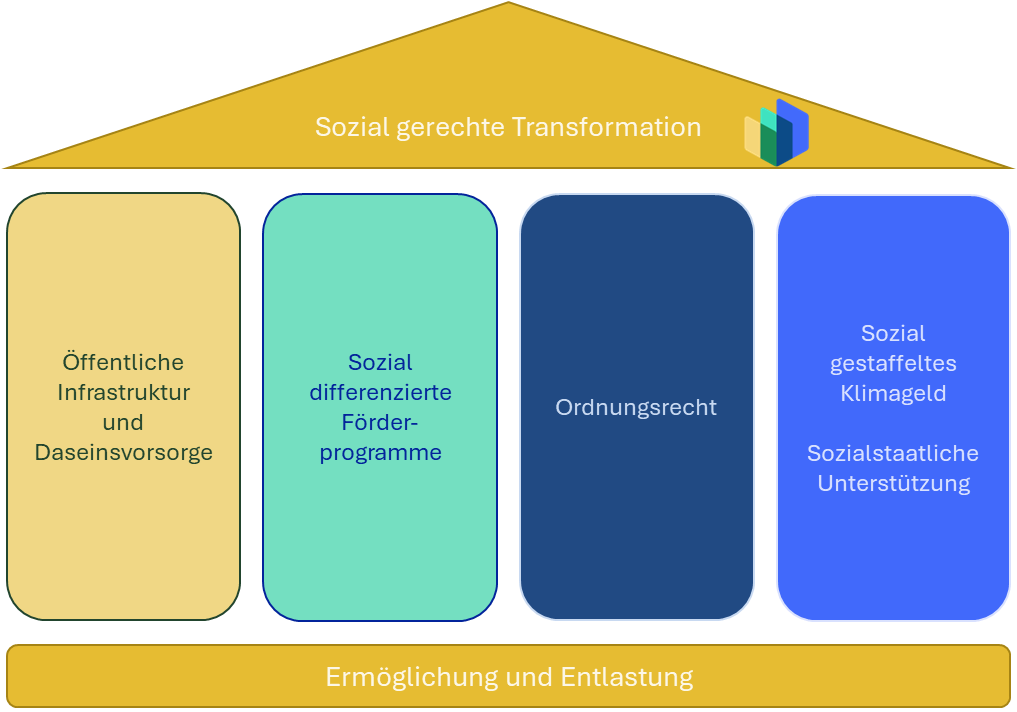
Infrastructure
The basis of a successful transformation is good public and social infrastructure. Only when a frequented bus stop is within walking distance or safe pedestrian and cycle paths are expanded does a low-fossil mobility alternative exist. Expanded electricity grids, financed progressively as part of public infrastructure, enable participation of everyone in the energy transition. Renewably operated heating networks enable the switch to renewable heating even in dense building areas, and communally usable spaces (e.g., guest rooms) mean that one’s own apartment can be smaller. Local provision of medical personnel or daily shopping options also contribute to traffic reduction.
Socially graded subsidy programs
The second pillar supports households more specifically, financially and organizationally, in the transformation. Subsidy instruments should be developed that enable lower- and middle-income households to switch quickly to a low carbon lifestyle. This can take the form of higher grants for lower-income households, income-dependent leasing models (social leasing of electric cars as in France), or support measures linked to vulnerability (dependence on fossil energies). Support should not only consist of financial transfers, but also assistance with applying for funding or planning the measures.
Regulatory law
However, infrastructure and subsidies are not sufficient. Especially when alternatives already exist, consumption patterns must fundamentally change, or larger investments must be made, the rules and prohibitions of regulatory law are required. They apply to everyone, regardless of income and wealth, and provide planning security to make sensible long-term investment decisions. In many policy areas, such as transport, regulatory law is an established and accepted instrument. In climate policy, it often meets resistance because it actually or allegedly intervenes in individual lifestyles. It is, however, central to ban the burning of natural gas or the installation of new heaters that can be operated only with fossil fuels at a certain point in time. A speed limit on motorways would also help reduce greenhouse gas emissions. In the "Climate Citizens' Councils," regulatory law receives high acceptance, higher than for pricing instruments.
Compensation
As a fourth pillar, there needs to be direct protection and compensation for ecologically sensible steering taxes such as carbon prices. These are likely to rise further with the introduction of the second emissions trading system for buildings and transport at the European level (ETS2). A climate dividend is a suitable instrument to this end. It secures the refund of revenues from carbon pricing in the BEHG and ETS2 to the people. Since lower incomes have a smaller carbon footprint, they would be relieved overall by the refund despite the relatively higher burden of the carbon price compared to income. As the challenges of transformation change over time, the role of climate dividend will also have to adapt, moving toward a hardship payment for households that cannot decarbonize by their own means (financially or due to legal constraints). Once higher-income households have completed the transformation to climate neutrality in the building and transport sectors, while low-income households still live in non-insulated apartments, a per-capita climate dividend would lose its progressive distributional effect and produce the opposite outcome.
The transformation to climate neutrality is in full swing, even if the current federal government applies brakes in some areas. A consistent social design helps to approach the necessary speed and, at the same time, reverse social imbalances. This matters not primarily for reasons of acceptance, but from a perspective of climate justice. It also brings opportunities to the foreground: a future-oriented and universally usable infrastructure, the overcoming of specific poverty situations, more health, more living comfort, more participation, and thus, more well-being for all.
___________________________________________
Editorial Note:
This article is produced in collaboration as part of a collaboration between Rethinking Economics International, Makronom and the Economists for Future DE and was originally written in German language. The 2026 contributions engage with ongoing debates on anti-authoritarian and anti-fascist perspectives on economic policy, with particular attention to how social security arrangements can help counter authoritarian and nationalist tendencies. Contributions in this series also explore welfare state design, property relations, pension systems, and institutional reforms with a view to strengthening democratic cohesion, ecological stability, and economic resilience. The views expressed in this article are the author’s own and do not necessarily reflect those of the participating platforms.
About the author:
Astrid Schaffert is a Policy Analyst at Zukunft KlimaSozial and has been developing the area of social climate policy. She prepares analyses and policy proposals, communication and implementation strategies, and brings these into the public discourse.
____________________________________________


